Target Shooting Clubs

For someone who left the ATC after enjoying shooting immensely I had no idea there was shooting available outside the military. That was a long long time ago well before the internet so maybe I had some excuse but other things had become more important at the time like beer, girls, driving and a career to develop.

Anyway for any cadet who enjoys their shooting there are lots of opportunities outside the ATC when you leave. For pure target shooting there is the National Rifle Association (NRA) for fullbore shooting and the National Smallbore Rifle Association (NSRA) for Smallbore, air and crossbow shooting. Both of these august bodies can point you in the direction of clubs local to you.

The Clay Pigeon Shooting Association (CPSA) governs clay pigeon shooting and there are either fixed layouts for Trap, Skeet, Universal Trench, Down the Line etc or Sporting layouts where there are lots of different “stands” from which you shoot at clays simulating “birds” crossing, going away, rabbits, driven etc. There is less emphasis on clubs in clay shooting than in the NRA & NSRA.

Joining the National Governing Organisation (NGO) will include insurance which gives a basic level of cover for your guns, third party insurance, public liability etc. Clubs also affiliate to the NRA or NSRA and thus get insurance cover for club shooting which includes cover for guests and visitors.

The International Shooting Sports Federation (ISSF) controls international shooting and the rules for World Cups and the Olympics.

Shooting is one of the only sports where men and women compete on equal terms.

My main interest is smallbore target shooting and there are a variety of disciplines under that umbrella - Prone Rifle, Benchrest Rifle, Lightweight Sport Rifle, Free Pistol, Air Pistol and Air Rifle and Three Position Rifle (3P) as shot in the Olympics and World Cups. I belong to a club which welcomes new members, has qualified instructors, club coaches, county coaches and even ISSF judges. The club can provide club guns to those who don’t have their own to shoot at the club or at competitions.

In the Olympics there is only 3P rifle, Air Rifle, Free Pistol and Clays and it seems that in the fullness of time it will become Air & Clays only.

The Commonwealth Games includes both fullbore and smallbore events plus clays.

However it takes a lot of time and skill to reach those heady heights.

Locally you can just shoot in your local club for fun but most clubs enter smallbore competitions organised at County or National level or by league organisers elsewhere in the country. Competitions can be for individuals or for teams. Teams can be club teams, county teams or even international teams. Often a Pairs entry can be made when you team up with a mate as well as your individual entry.

One of the advantages of smallbore target shooting is that competitions are “Postal”. Shooters from all around the country can enter and shoot a competition and the shot cards are sent away to a central scorer who scores all the targets and publishes the results.

There are also shoulder to shoulder Open shoots either indoors or outdoors where you compete against other shooters in the county, region or nationally. In this case everyone who has entered travels to the club organising the shoot and shoots shoulder to shoulder against all the other competitors.

Shooting outdoors in the wind is whole different ballpark. Wind is never constant; it varies in direction and strength all the time but suffice to say that a theoretical constant 10mph crosswind will blow a 40 grain .22 bullet 4 inches off course at 100 yards! Then there is mirage to contend with in very hot and apparently still conditions.

That’s probably enough to start this thread off but do fire away with any questions and I’ll add other topics as time passes if there is sufficient interest.
Smallbore target shooting is done mostly on paper targets though there are some clay disc shoots which are becoming rare.

Prone shooting indoors is at 10 bull targets at a variety of distances but usually 15 yards through 20 yards, 25 yards and 25 metres. and so the bulls are proportionate in size to the distance. Not all targets are round bulls with 10 scoring rings. There is the Skirmisher target which has 8 small ovals and the aim is to get as many scoring shots off in the time limit available. You have to have 2 scoring shots on each diagram before any 3rd shots count. Other paper targets are elliptical targets, animal targets and the pimpernel where there is a red dot in the middle of the black bull and the objective is to remove all signs of red with a limited number of shots. There are also rapid fire competitions where the 10 bull target has to be shot within 90 seconds.

Outdoor shooting is at both 50m and 100 yards where you have unlimited sighters and twenty shots to count. An English Match is 60 shots at 50m to count so 3 targets with 20 minutes time limit for each of the 3 targets. A Scottish Match is exactly the same but 60 shots at 100 yards. A single Dewar is one card at 50m and one at 100 yards and a Double Dewar is 2 cards at each distance.

There are a variety of competitive smallbore target prone/3P rifles from the likes of Anschutz, Walther, Bleiker, Grunig & Elminger and Unique There are still some BSA Martini actions in use.

The cost of a rifle depends on what you can afford. We just bought 2 Anschutz rifles for the club that have been well used from another club for £150 each. You can spend up to about £9,000 for an all singing all dancing brand new Grunig & Elmiger which is frightening!

The rifles nowadays have virtually infinite adjustment to suit all shapes and sizes of shooter. There are lightweight models for the ladies and youngsters.

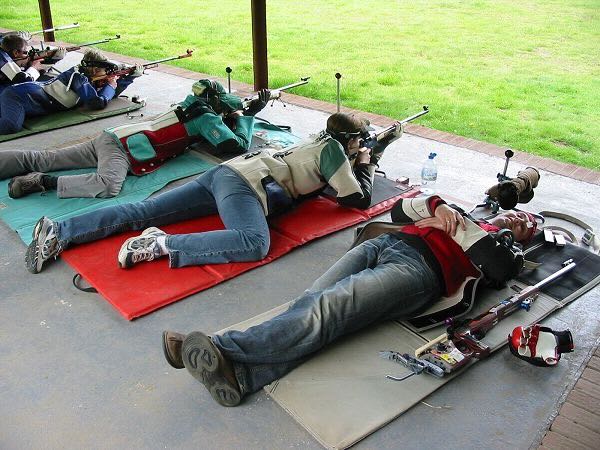
Prone shooting requires a shooting jacket which is usually made of tough double thickness canvas or leather or a combination of both. This is to provide support and to carry the sling from the left shoulder to support the rifle in front of the handstop. You need a shooting glove, ear defenders and a spotting telescope on a stand. You will probably get shooting glasses where there is a lens to match your prescription but is designed so that you focus on the foresight.

Ammunition is sold in boxes of 50 which you can buy from your club ranging from about £6 per box up to about £16 for 50. Ammunition must be sub-sonic so have a speed of less than 1100 feet per second.

3P or Three Position shooting is Prone, Kneeling & Standing and they also wear shooting trousers and boots to help them keep still whilst standing & kneeling. They move about like Penguins! A 3P competition is where you have to shoot 20 shots standing, then 20 shots kneeling and then 20 shots prone, all within a time limit.

Prone shooting, shoulder to shoulder, at the annual NSRA smallbore meeting at Bisley.

The shooter on the right has clearly finished and is relaxing!

One of the fundamentals of competition shooting is that you only compete against shooters of broadly the same standard as yourself. This is achieved by shooting in Classes. There are 5 classes nationally at the Bisley meeting being X for the very best, A for the very good, B for the good, C for the average and D class for the beginners and those with a low average. When you win or come say in the top 10% of your class you get promoted to the next class up and likewise you can be demoted!

In other competitions you have to provide an average of a number of scores from your indoor shooting. It could be the NSRA national winter league average, your local county league etc. Your average will place you in the division of the league with those with the same or similar average. Averages need to be certified by your Club Captain in order to reduce the possibility of cheating.

Shooting Clubs themselves vary enormously in terms of facilities, members and what they shoot.

Many clubs originated from Home Guard origins after WWII and so tend to shoot prone only. Some are winter only clubs and only shoot indoors in the winter and play cricket in the summer!

Some only have one range which might be the village hall one night a week or other clubs rent a facility so its theirs anytime they want to shoot.

If a club only has one range but shoot more than one discipline then each discipline tends to be allocated one night per week. Members from different disciplines tend not to see other shooters and the club loses its identity with various factions.

My club is fortunate to own its freehold and we have merged with 3 other clubs, pooled our money got loans from members and grants and now have 5 ranges being one for 20 yards air pistol and lightweight sport rifle, a 10m range for air pistol and air rifle shooting and 2 25 yard ranges for prone and Benchrest. We also have a 50m range.

So if you want to join a club it’s best to join one with more facilities and ranges. At our club we can shoot 24 hours per day if we want, indoors, providing that there are a minimum of 2 full members present at any time.

Some clubs have their origins in Industry and there are Great Western Railway Staff Association Clubs in the Westcountry. The Stock Exchange has a club underneath the exchange. Such clubs are fewer in number as business has become more competitive and the money does not stretch to sports facilities.

Clearly clubs like mine are hard to come by but it’s run by unpaid volunteers who fitted out the building once it had been built to keep the costs down. We have no employees and only have paid work done if we can’t do it ourselves or by law it has to be done by someone qualified e.g. Electrics.

To join a club you have to do a probationary period of 6 months. When you apply, your details are given to the police who check to see if you can be trusted with firearms. If you have a criminal conviction, mental health issues or other intelligence that stands against you the Police will deem you to be unsuitable to have access to firearms and your membership cannot proceed.

Different Clubs run their finances in different ways. We have a subscription that lets you shoot when and as many times as you like whereas others have a range fee to pay every time you want to shoot. We provide our paper targets free but other clubs charge for them. Everyone has to buy their own ammunition. Our full member subs are £20 per month for adults and £10 per month for Juniors which is up to age 18 or whilst still in full time education e.g. University.

Clubs, by law, have to be Home Office Approved which in practice means that they are inspected periodically by the Police to ensure that the club is run properly, has a secure armoury, its ranges have been certified to be safe and proper records are kept of who shoots which particular gun and when etc. We have some of the most stringent laws about guns and shooting in the whole world and shooting must be regarded as a privilege and not a right.

Firearm and Shotgun Certificates

You only need an FAC or SGC when you want to buy your own gun or guns. You can happily shoot at a club using a club gun held on the club’s own FAC without having to have your own FAC.

The advantage to owning your own gun is that only you use it so it’s set up for you. A club gun might be used by a number of different people and so you have to readjust it to your settings each time you use it. Of course, you could also turn up to shoot and find another member using the gun that you prefer to shoot.

When you start to shoot in open shoulder to shoulder competitions at other clubs it means that you have to rely on a fellow club member FAC holder taking a club gun with them for you to use and carry an official permission relating to that gun.

So most people like to apply for an FAC so that they can buy their own gun or guns.

You do not need an FAC to shoot air rifles or air pistols unless the power of the airgun exceeds 12 foot pounds.

To apply for an FAC you must demonstrate a good reason to own a gun. Target Shooting is such a good reason but you also need to belong to a club or range where you can use the gun. You need to supply references as to your good character and have no criminal convictions against you. Most importantly your doctor must complete a medical reference for you which basically says that you have no medical conditions that prevent you owning a gun or mean that you would be a risk to the public if you owned a gun or shotgun.

In your FAC application you need to specify the type of gun or guns that you want to buy. For example:- .22 Rimfire Target Rifle, .22 Rimfire BenchRest Rifle, .22 Rimfire Semi-Automatic Rifle, .22 Rimfire Free or Long Arm Pistol.

You also need to apply for the amount of ammunition that you wish to be able to buy and hold.

Once you are granted your FAC you have an authority to buy what was granted to you on your FAC so can then go off to the gun shop and buy what you are allowed to buy or buy a gun from another FAC holder. The details of the gun bought being Make, Caliber, Type of Action and Serial Number then have to be notified to the police within 7 days by both buyer and seller so the police know the particular guns that you are allowed to possess at any given time.

You will need to show your FAC every time you buy ammunition and it gets recorded on the FAC. This is good as you can then demonstrate good reason by the amount of ammunition you have used when it comes to renew your FAC in five years time and want to increase the amount of ammunition you are authorised to have.

If you want to change the gun you own it is not straightforward. You need to apply for a variation to your FAC to get authority to buy another gun. Once you have this you can then buy another gun. If you sell the original gun then that authority for that gun is lost.

SGC’s are currently more straightforward in that once you have a SGC you can buy and hold as many as you like and you can buy shotgun ammunition freely at gun shops without it having to be recorded. Once again you need to have a good reason to own shotguns and have somewhere to shoot like clay shooting grounds or a written permission to shoot over a farmers land to shoot vermin.

There are however proposals to make the laws applicable to shotgun licensing as stringent as those for firearms following the terrible shotgun shootings in Plymouth.

Lightweight Sport Rifle Target Shooting (LSR)

This is done using a semi-automatic rifle with a magazine and telescopic sights shot from the standing position. When pistols were banned following the Dunblane massacre in 1996 LSR took over many of the old pistol shooting competitions.

Whilst these guns have the same range as any .22 Rimfire rifle they tend to have shorter barrels making them less accurate than their “Long” rifle counterparts thus well suited to shooting pistol competitions at up to 50m outdoors and usually 20 yards indoors.

Fullbore semi-automatic rifles have no place in civilian hands and there is no good reason or justified use for them. They were banned in 1987 following the Hungerford massacre. They are a military combat weapon or for use by Police responding to firearms or terrorist incidents.

Competitions can be either “deliberate” when 5 shots are put on a single bullseye target at 20 yards repeated as many times as the competition requires. There are also turning target competitions when the shooter holds the gun down at 45 degrees towards the ground and when the target turns to face they have a short time to aim and fire a shot before the target turns away again. Repeat as many times as required by the competition.

Competitions can also be held outdoors and therefore subject to wind and mirage.

There are also steel challenge competitions where “knock down” targets are placed on the range and there are time limits to knock down say 10 targets at various distances.

Semi-Automatic guns can be notorious for jamming if the guns and magazines are not kept scrupulously clean and reliable ammunition used. They work by the previous shot forcing the action backwards against a spring so the action then automatically rebounds forward picking up another round from the magazine and chambering it ready for it to be fired when the trigger is squeezed again.

LSR’s can also be bolt action rifles but with a magazine and these can often be more accurate than a semi-auto as the automatic movement of the action can alter the aiming of the rifle. Biathlon winter shooters use a bolt action .22 rifle with a magazine.

The most commonly used LSR is the Ruger 10/22 so called because of its standard 10 shot rotary magazine in the .22 rimfire calibre. There are more and more types of LSR becoming available similar in design to the Colt AR15, the military version of which was the Armalite M16 but which had a fully automatic function and so not available to the public in America. Rugers in their basic form are cheap but can be enhanced with different stocks, triggers, actions, barrels and other accessories.

Benchrest Shooting

This is a relatively recent addition to small-bore target shooting. It’s taken off in the last 6 years or so. Basically you use a prone target rifle, remove the handstop and bolt a flat block of wood/aluminium to the Bottom of the forend so that it will rest on a rest adjustable for height. You sit at a bench with no special clothing other than a mitt on the left hand which supports the stock between the handgrip and butt. The sights are telescopic sights and you need magnification up to about 30 times and a fine level of adjustment. When shooting the butt must never touch the bench, only rest on the mitt and in your shoulder.

Shooting can be at 25 yards, 50m and 100 yards so both indoors and outdoors.

The 25 yds target has 10 bulls like for prone but the centres are cream and not black as you can’t see the black cross hairs or dot of the sights on a black bullseye.

Scoring is the same as for prone shooting but the scores are consistently higher due to the telescopic sights and the stable platform of the bench and rest. To combat too many achieving the top scores there is an X count for every perfect centre shot which does not touch the first ring in addition to the score ex 100. This inner bull is smaller than the 10 ring on a prone target and about 1-2mm bigger diameter than a .22 shot hole so X’s are difficult to get. You need very good ammunition to achieve such accuracy.

It is fair to say that it is very popular with the elderly who can no longer get up and down to shoot prone and can’t cope with the jacket and sling of prone shooting. There are no doubt younger shooters who would take issue with me on this! (I recently bought an Anschutz Match 54 for our club from a lady who was retiring from prone shooting at age 98!)

Many prone rifles get converted to Benchrest by the addition of the wooden block and telescopic sights. Anschutz do now make a dedicated Benchrest rifle if you have >£3k to spend but the telescopic sight would be a further expense on top of the rifle.

In the Uk there are NSRA Benchrest rules and Worlds Benchrest rules and the two types use the same types of rifles but different targets.

Fullbore shooters have F class which is Benchrest shooting but there may be other versions but I’m not into fullbore as it’s too expensive! Evidently the World Championships of F Class are at Bisley in 2026 in the week which would normally be the NSRA small-bore week so our week has had to be put back a week as there would be no accommodation on camp!