The RAFAC Supervisory Care and Welfare Support Version 1.00 Dated Jun 26 has finally been published.
For those with access to SharePoint, here is the link.
RAFAC Supervisory Care and Welfare Support Version 1.00 Dated Jun 26
I’m disappointed I’m finding out about this via ACC and not it appearing in any of my inboxes for something as significant as it is…
I can’t even spot an announcement on SharePoint anywhere
2 Likes
It might do, but to save inbox overwhelm a lot of stuff gets grouped into updates that are emailed out.
2 Likes
It appears to have a whole other policy as an annex of that policy…
RAFAC TRAVEL AND TRANSPORTATION POLICY DIRECTION AND GUIDANCE
Surely this should be part of the appropriate ACP/ACLI/ACTO?
Are all the superscript notes missing? I think it’s called superscript anyway. I can see the numbers, but they don’t seem to refer to anything.
Is the 1:8 ratio for 12yos present new? I don’t handle that kinda stuff on unit so it’s not something I’ve massively read into before (I don’t think I’ve been IC of an event worse than 1:6 haha)
Yes, 1:8 is now a thing with U18s
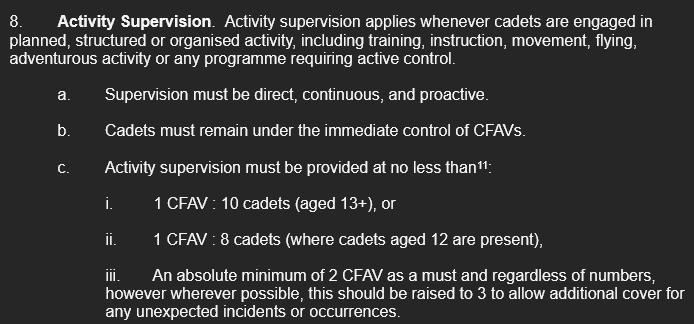
I’m intrigued by the statement ”Supervision must be direct, continuous and proactive”. Remote supervision of DofE groups and things like Ten Tors do not follow this. I really think that “must” aught to be “should” there, as there are legitimate times when supervision is not direct.
6 Likes
That was always in the NSPCC guidance that JSP 814 refers to variously as advisory and a minimum.
The most challenging part of this is over night accomodation ratios, expectations etc make residential with the current estate and staffing challenges near impossible.
I would imagine summer camps are now at risk as a result of increased staffing requirements
3 Likes
For example, there can now be no AEF or Gliding where as there cannot be two CFAVs in the aircraft with a cadet and certainly no solo cadet flying!
6 Likes
Also is the reference to EHCP as ‘early help and care plan’ correct as if always read that as Education Health and Care Plan?
10 Likes
It would require more staff than I have - ratios are met on my unit via the combined total of CCF(A) & CCF(RAF) CFAVs 
2 Likes
The Air Scouts solve that particular problem with a GoPro.
Too risky, could be hacked. Just stopping flying is safer.
3 Likes
Especially with mandatory maximum hours for staff. If you’re up doing stuff from 0630 until 2130 you’ll be needing two ‘shifts’ now from my reading?
2 Likes
Policy just says “CFAVs” 
Look, I hope you lot aren’t suggesting that this is a policy written by some half-wit who had no understanding of the environment and organisation it was being written for, or indeed of normal, civilian safeguarding procedures?
Any suggestion that this this idiocy - I mean well researched, thorough, and peer reviewed body of work - won’t be hurriedly adopted, vigorously put into place, then gawped at in horror as it’s implications manifest themselves, and then just as hurriedly dropped like a scalding turd are shocking. Shocking I say…
There’s absolutely no one working in any professional capacity within child care, education, or child protection who would not know - instantly - that an EHCP did not mean early. You therefore have a good understanding of who it wasn’t written by, and therefore a good grasp of its worth…
I would say it’s frightening, but I’ve got used to the antics of these morons, so now I just sigh….
11 Likes
It does… but I suspect I will struggle to get any of them to support a blue camp, with already supporting green camps for example. We shall see.
1 Like
Unintended consequence of this - sqns stop accepting under 13s.
NSPCC guidance is for off unit activities & is general terms rather than formal accredited advise.
3 Likes
This is one of the most confusing, contradictory and poorly written documents we’ve ever produced and that’s saying something.
It has 13,765 words and it’s impossible to be an actual useful, referenced policy document. It’s unintelligible at points, makes use of random language and wording, doesn’t seem to know what it is trying to achieve and is essentially, if read as written and implemented by people who apply it literally, going to end a lot of activity.
7 Likes