Mad Idea: Overhauling the CFAV Ranks

I relax by deep-diving on stuff, including things that aren’t necessarily bad, but are odd enough to trigger the ‘tism…

The CFAV rank structure is one such thing.

I hasten to add this is my thinking as a random individual. Nothing about this is formal or backed by the organisation.

My pitch…

CFAV recognition is inconsistent, ranks sometimes prevent us from appointing the best person for the job (unless we invoke the mother of all range ranges), and all of this is made worse by the fact we set the base really high by appointing inexperienced volunteers to the rank of sergeant (which should really indicate significant experience) and we don’t attach commissions to specific enhanced training or appointments, which undermines them significantly in the view of many people.

So I’ve been reimagining the system, and I’d love input from the hive mind. I may propose it formally, if we have something like the ASTRA process available.

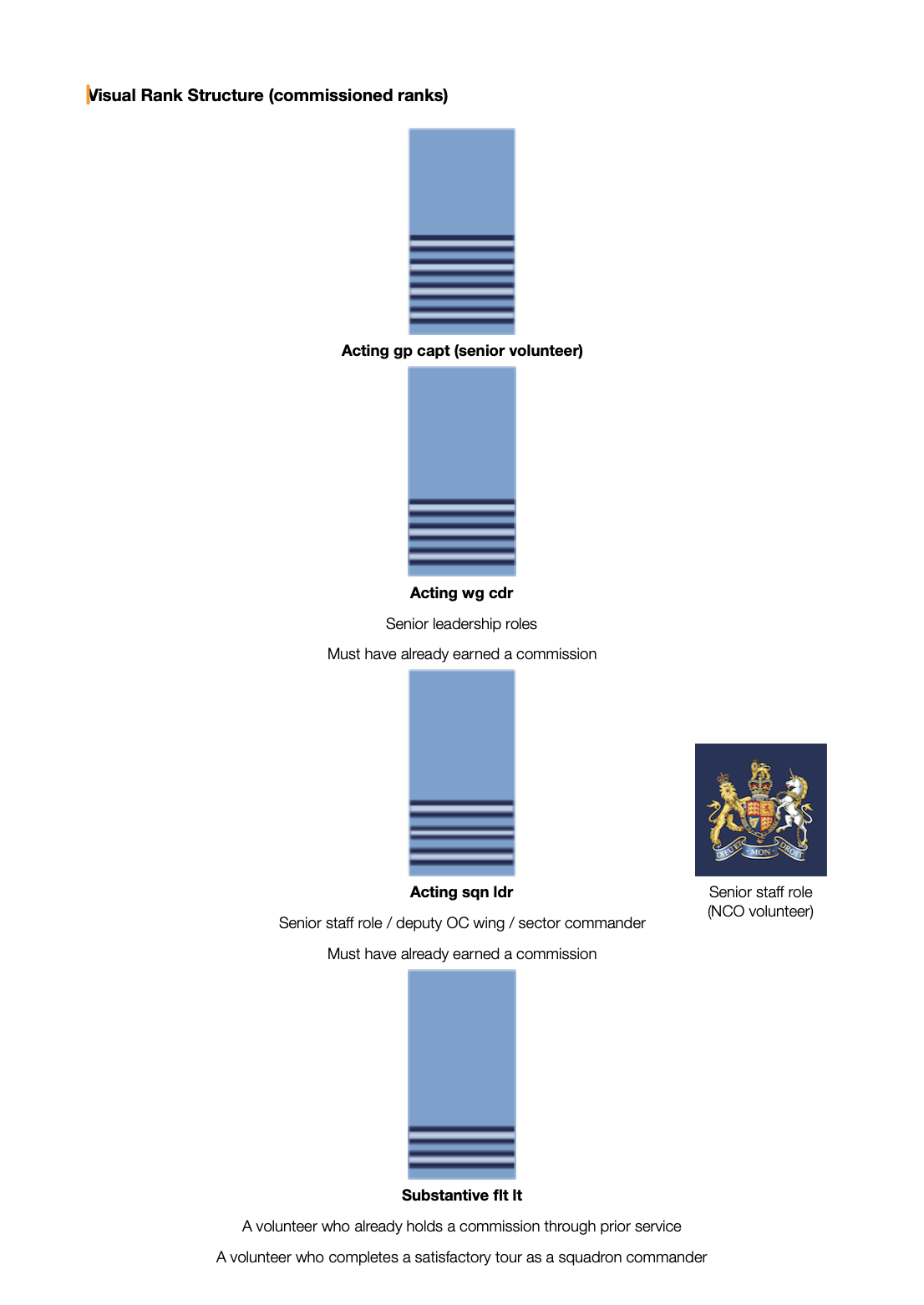
Screenshot below, but essentially the key elements of the proposal are:

  1. Staff start at AS2 (it’s good enough for reservists). This signals probationary staff.

  2. Sergeant becomes the highest substantive rank for most staff, admitting you to the privilege that is the WOSM and indicating significant experience and a couple of core competencies. It is also the default rank (acting, if required) for the squadron NCO, training officer, and adjutant — recognising the work involved for those posts.

  3. Flight sergeant is by competency-based appointment, signifying responsibility held as either a staff officer (for current OF2 roles) or a squadron commander.

  4. Warrant officer is the same principle, but for traditional wing+ WO roles or OF3 staff roles.

  5. Commissions become competency-based recognition for those who have held effective and sustained unit command, returning significant meaning to a commission and preventing people choosing to pursue a commission in a way that isn’t tied to any special training or sustained appointment. Flt lt is the lowest commissioned rank used because it now signifies significant and credible experience. In order to hold command above this level (sector command, deputy OC wing, OC wing, senior vol), you must have obtained a commission through this route (or have one from prior service in the military). The only roles not open to a commissioned officer post squadron command are the traditional WO roles (WWO, RWO, WORAFAC), because our rank system will always have clunky limitations.

This allows most roles to be done without volunteers jumping through the one-way commissioning process. It also means volunteers don’t have to juggle the largely meaningless (but still significant) decision of whether they feel they’re better as a SNCO or commissioned officer before they’ve even done a day in uniform. If choosing a commission, this currently stops a new volunteer entering uniform for a year, which is counter-productive.

This initial concept allows volunteers to be recognised well, with acting rank possible in a consistent manner, but also establishes some important but easy to obtain core training that will set them up for success if they want to promote.

Non-commissioned squadron commanders would receive enhanced support as part of their development journey as a potential commissioned officer.

That’s my initial pitch. I’d love to know everyone’s thoughts on this concept.

Edit:

Commissioned side added. Once commissioned, you fill a lower-ranked role as a substantive flt lt. non-commissioned volunteers can still do senior staff roles, but they’d wear acting warrant officer.
1 Like

What about CI - where do they fit in?

How would this align with the other cadet forces?

the nature of volunteers is they often have more experience & join later - would it be appropriate for 60 year old AS1?

How long would it take people to progress through?

I think what people forget with regular/reservist ranks is they are very much linked as pay grades to decision making, responsibility & autonomy.

What you would need to do is write the role profile expectations & the put it through a HAY process.

Very often what we expect in terms of technical knowledge of our volunteers is a lot higher than what is expected of regulars albeit a bit niche.

Have you looked at running the roles through HAYE group job evaluation method?

once you’ve got the points determined you can then match to regular /reservist ranks.

a starter for ten would be just drop the TORs for an OC into AI & ask it score it?

My personal view on the rank structure would be to bin off completely WOs & SNCOs so you just have officers & CIs although I appreciate that this view is jaded due to past experience.

1 Like

Aren’t there RAF roles starting at Sergeant, where they have greater responsibility from day 1 (and Corporal for the same eg RAF Police)? I think we currently work the way we do because we, similarly, have greater organisational responsibilities from day 1 - we are responsible for other people (cadets), not the execution of a task - hence, we start at a higher rank.

I think there needs to be a greater push for uniform across the organisation, and I think personally the default entry point should be Sergeant. CI, to me, should be the exception rather than the norm.

I then think there needs to be a push to make commissioning more streamlined, and this should be more tightly linked to senior appointments on the Squadron. Given the chance, I’d bring back Flt Lt for officers who have genuine experience (in executive roles) and are ready for command, and for junior squadron OCs. Senior OCs with x years experience can be Sqn Ldr (not linked to size of squadron as this is a postcode lottery as much as anything else). WSO/OC Wing works the same as now, and similarly as now SMEs should be respected for their experience rather than rank, and therefore don’t hold specific rank except where absolutely necessary.

We’re not junior service personnel. We’re leaders, holding significant responsibility for young people. Our rank structure respects and signifies that, IMO.

3 Likes

Not that I think it matters, but the ACF has sgts running detachments and cadet under officers.

I went through phase 2 training with an LAC (now AS2) in his fifties. He’s now a sqn ldr.

One of my AS1s is literally a nuclear rocket scientist, with multiple doctorates. He and others are let loose to brief 2*s with critical assessments for decision support.

I think you’re underestimating the technical knowledge of regulars — with a few exceptions, the RAF is a very technical service.

1 Like

I think the cadet U/Os aren’t a thing anymore (unless you mean adults who are U/O) - the ACF has changed a lot over the last view years.

It does matter because the CCF which are a separate corps with some RAFAC officers (normally ranked Sqn Ldr or Wg Cdr) being the contingent cdrs commanding the multiple sections.

You would either need to change all cadet forces simultaneously or change just the ATC.

Isn’t there already a disparity between the rank structures of ATC and CCF(RAF)? As with SCC and CCF(RN)?

Almost anywhere. This is a proposal largely about CFAV ranks though.

Under this concept, a CI would be able to do most things without worrying about rank expectations, as most roles are non-commissioned and the commissioned status changes to recognising a well-exercised competency, rather than something you get after some interviews.

2 Likes

This could certainly be a consideration, but then they are a separate organisation and we don’t have control over everything.

Certainly many ACF detachments are run by sgts.

So it’s valid, but let’s park the cadet forces parity argument for now and imagine that we could do it.

What do we then think about it?

1 Like

I don’t disagree with your points, but divorce your expectations from the parent services for a moment and imagine it from the POV of being able to provide real progression to our own people.

At the moment, our SNCOs basically have nowhere to go and get demoralised at the idea of FS taking ages. Give them 8 years and there’s nothing left, but they haven’t earned it either.

Our commissions aren’t tied to training or strict appointments (because many NCOs and CIs hold these same appointments, and anyone in uniform does the same training), and so the commission means very little too.

The core idea here is providing us our own system that draws from the parent service but recognises our people on our own terms, providing development through our own system and recognising with granularity the effort our people put in.

We wear “RAF AIR CADETS” to signify our significant youth responsibilities. The rank structure can mean what we make it mean for us.

2 Likes

Firstly I would like point out that “Thought experiments” such as this are always useful in helping to understand our current situation.

It’s just as important to consider the “why we don’t” as to consider the “why we do”


I think your proposal has too many ranks that make it over complex.

A tweak you could do is that pre-CIC Is that the individual is AS2 / SAC. This is because they would already have pre-knowledge as either a CI or a cadet.

uniform staff at all levels are expected to be supervisory so certainly shouldn’t go below Cpl.

I would ditch the acting because this just complicates & can be within the gift of the organisation to fill a need anyway.

I’d go for a flat system - don’t bother with ranks, simply have roles.

Personally, coming from a regular Army background, I’m uncomfortable with the kind of ‘instant 20yo Sergeant’, just as I think that the idea of a 45yo who runs their own GIS company and organises a week long AT camp for 50 kids being a SAC is bizarre.

The RAF’s rank structure doesn’t match our organisation, so instead of endlessly messing about with a fence post and trying to make it a cowshed, just grasp the nettle and live with the cowshed.

The Scouts manage it…

3 Likes

Surely it’s simpler?

Positions are tied to roles, so if you go straight from CIC to squadron command, you wear the rank for your responsibility. But if you drop it after a year, you pick up your substantive rank.

Substantive rank climbs based on experience, and is the fallback for those without portfolio.

This plan actually sees many people holding sgt and FS the moment they’re in a uniform.

Commissions recognise time in effective command, and they can then do almost any role afterwards. But we still have loads of units, so it’s not a bottleneck, but it does stop people collecting them with no intention to command a unit.

This is how it works in CCF land:

I am Section Commander/OC of a CCF(RAF) section, 90 Cadets and am a Flt Lt.

If I step up to Contingent Commander, I would be ultimately responsible for the Section Commanders of all Sections, plus the purple Recruits Troop all in totalling 170 Cadets and be a Sqn Ldr.

If the total size of the Contingent grew in excess of 200 Cadets I would be a Wg Cdr and one of the Section Commanders could have a secondary duty of Deputy Contingent Commander at OF3.

All other Section Officers are OF1/OF2 depending on time served.

2 Likes

I do broadly agree with you, so this is my attempt to make the ranks work better by redefining them for our organisation in the optimal way.

If we drop ranks completely and step away too much, we might as well become air scouts.

1 Like

So I did consider an officer-only approach.

I opted for my initial concept above because I ultimately felt that commissioned-only was even less likely than re-defining how we use our existing ranks (plus JRs).

I think we’d just have to accept that the ATC and CCF will never cleanly align.

But if our people command squadrons, they would end up as substantive flt lts.

2 Likes

I forgot to mention that the SAC I mentioned from my phase 2 training was a director in a major utilities company.

1 Like

So it’s already different from the ATC then?

1 Like

We’re definitely comparing apples and oranges if we try justifying sgt for probationary staff because they’re youth leaders.

It’s not saying one is better or worse, it’s just observing that we’re not the RAF, so we should be open to making our rank structure work better for us, even if that means a lower starting rank. We wouldn’t still argue all non-commissioned ranks should start at WO.

1 Like

Why don’t we drop ranks - work out the structure & the put back in the ranks at the appropriate level?

Appointment based rank does kinda work but perhaps we need to look at the specialisms.

I think the sea cadet promotion matrix would probably be of interest to you. Everyone starts as a APO / PO, then you have to do at least one specific training weekend & a portfolio plus qualifications for each promotion.

the down side is there are a lot of POs & S/Lts but when you see a CPO or a WO (which are rare as hens teeth!) you know they have a lot of weight behind the rank.

This is effectively what I did when formulating this proposal. But still needing to work within some realities, such as commissioning being a one-way road.

If you started from scratch, how would yours look?