South West Yorkshire Wing for sure.
But absent that one example I’ve seen, I can’t think of one.
South West Yorkshire Wing for sure.
But absent that one example I’ve seen, I can’t think of one.
Sussex Wing?
B&G had a female OC Wing for a good while, she has a HQ post now.
No, tbh, my development process has been somewhat difficult to progress in the SCC. I was excused the basic course due to experience, but the next course up seems few and far between. I received an invite to one last may, it was weekdays in June. So I couldn’t go, and haven’t heard anything more since!
That’s a shame hopefully that’s something you can get sorted - whilst it may be a bit of a trek perhaps other area could help.
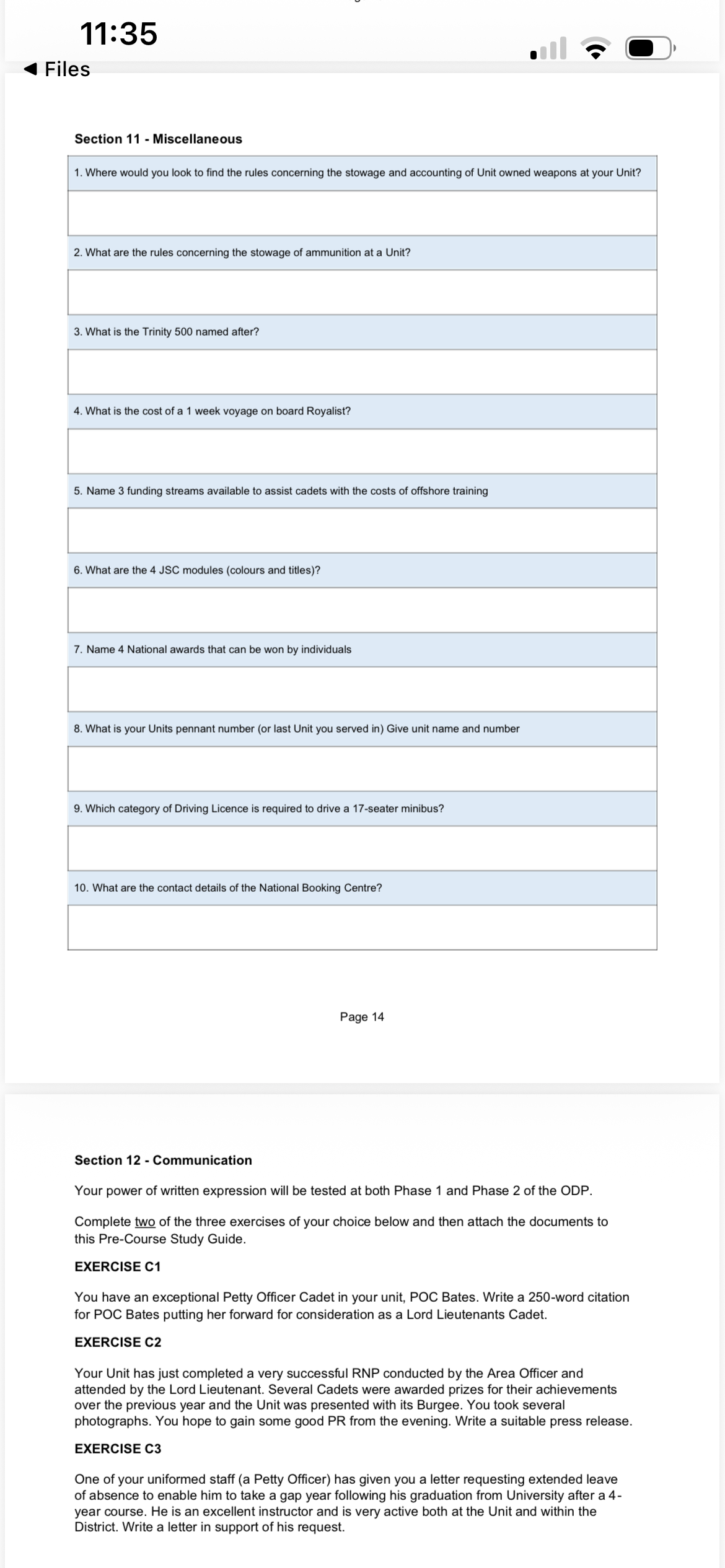
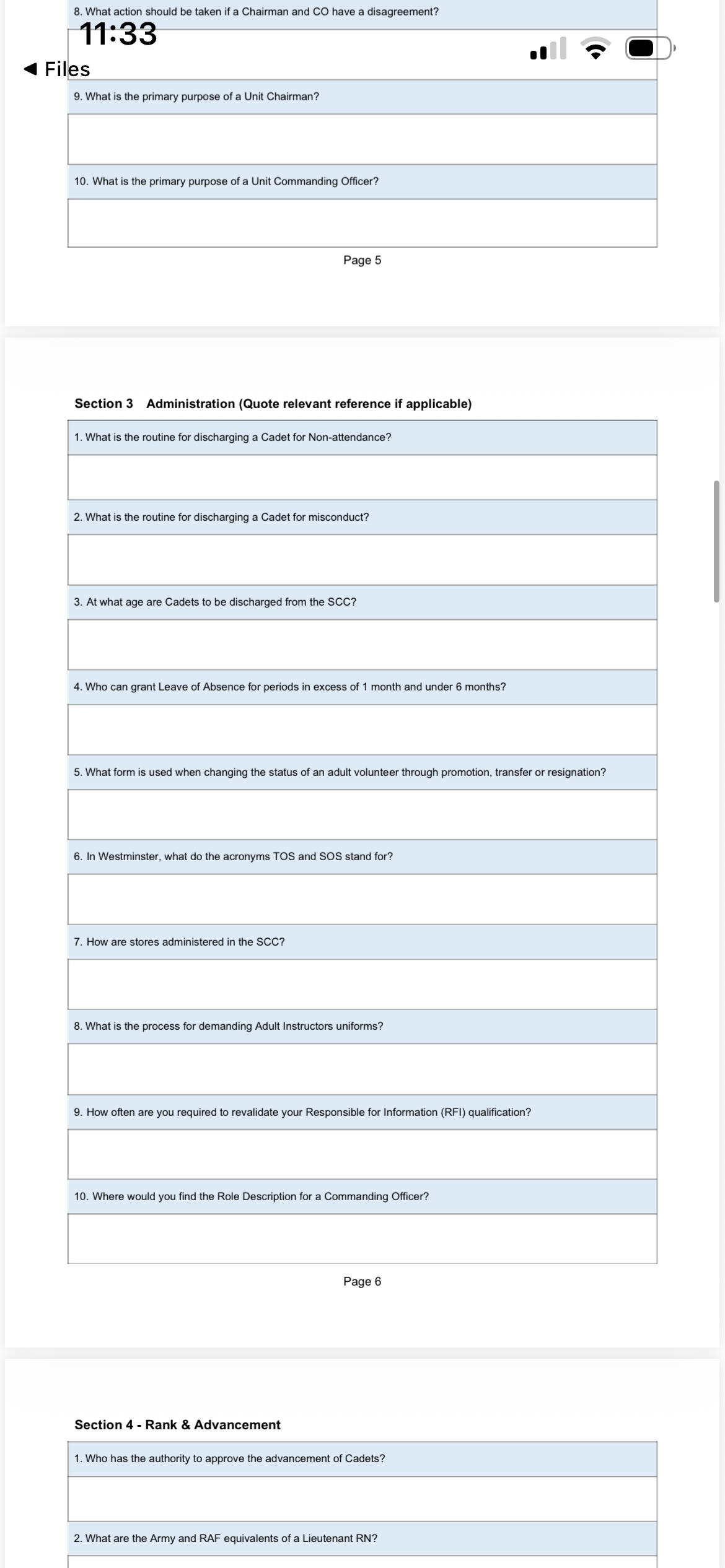
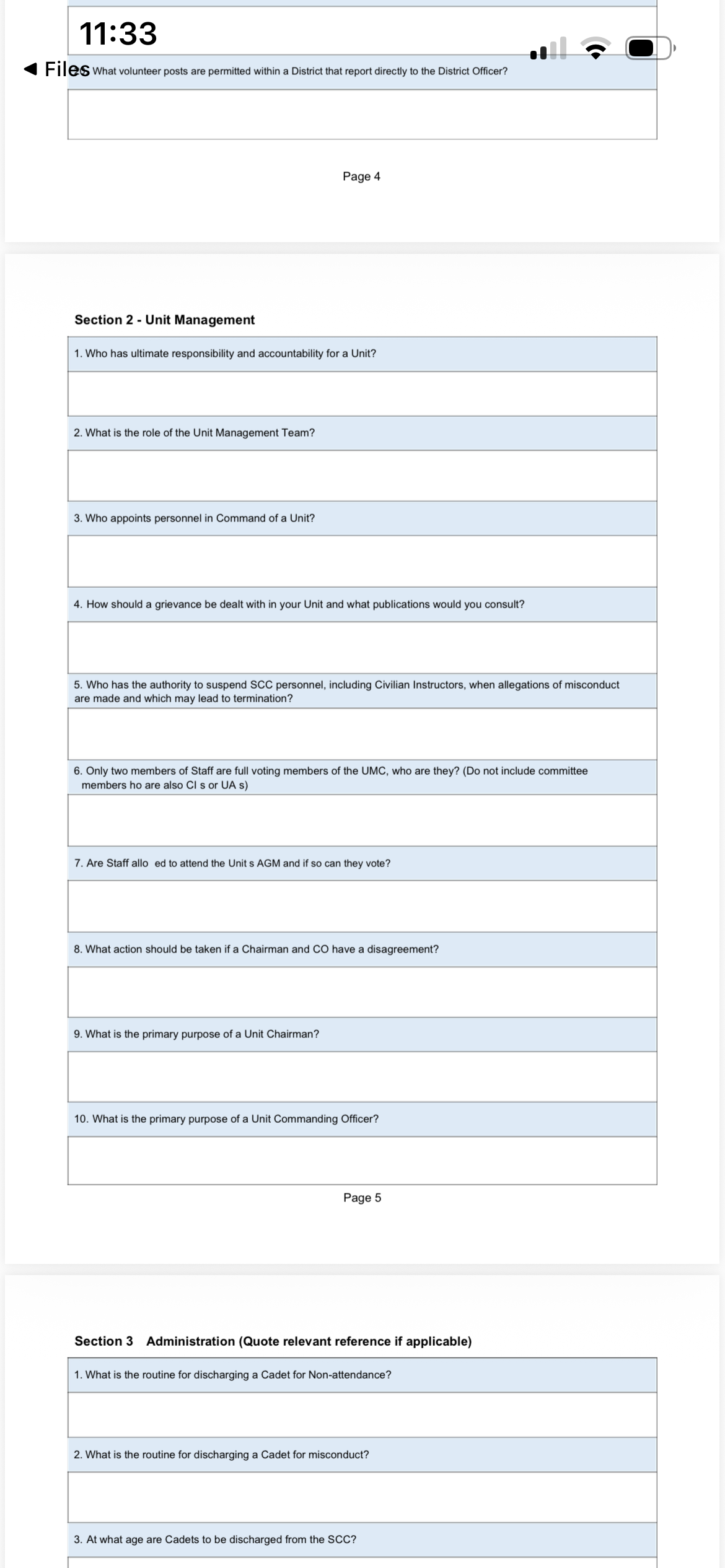
I’ve taken screen shots of the file I have which the sea cadets for those starting their commissioned route.
In short a lot of questions which are simple on the surface but like the RCO test you have to be able to give references. There’s also a couple of writing exercises to help ease prospective candidates in.
@OC.1324 this might help you with a starter for 10 on the officer development.
The other suggestion I would add is have them run off Sqn events making good use of the comments box to record their decisions.
Perhaps even have them check the events of others in the way an OC does to help get them use to event administration & management over sight 
ok so seems there has been at least three although out of 36 Wings and 85 years it isn’t a great advert
To be fair it’s nearer 40 years, 30 if you allow for development lag.
Although considering the WRAF was only merged in 1994 were female officers in the WRAFVR referred to as section officers or did they use the standard RAF ranks.
The RAFAC has 48 CFAVs at Wg and Regional level. 34 OC Wg, 6 RSSO and 6 RAvO. Not sure about HQAC but I know of at least 1 Wg Cdr Hall Head of Mental ?Health and Wellbeing.
Going on our stats of about 35% female staff in the corps, there should be between 8 and 16 female CFAVs at Wg Cdr rank. There should be two to three female CFAV in every region and dropping to one now and again and going up to 4 or 5 depending on appointments of staff. It should never go down to 0.
Very true, our wing doesn’t do as badly as some for ratios but it is still very male dominated, fewer than a fifth of our OCs are female for example. And then that means a smaller pool to draw on for promotion to sector commander or WSO roles.
North Scotland Wing, formally Highland Wing. The female OC Wing was in post over ten years before retiring last year.
Previously, was indeed a woman. Currently a man though.
She wasn’t exactly a great example 
So moving back to topic a little (& taking a bit of inspiration from the sea cadets) currently if someone wishes to move into uniform it’s a bit of an ad hoc process.
Why can’t pre-uniform be done regionally /nationsl rather than at wing level.
Still keep the local suppprt but have a national programme almost an “academy” intake.
You apply each year to join the September class have development throughout the year with the aim being that you pass out as a cohort?
People can then get support from their tutor group & it then injects greater consistency of training quality rather than leave it as a cottage industry at local level.
I’d also been thinking of an annual camp for senior cadets who are transitioning to CFAV status.
An opportunity to mark the transition, introduce them to the mess, teach them loads of practical skills (including creating RAs and SMS events for the very activities they’ll cover on the course) leadership, adj, training officer, and Sqn SNCO training all in one.
All making use of the fact they’ll have a block of time available in the summer as they’re leaving school (or are at uni).
Could maybe even put them through other specialised training like weapons instruction / air rifle RCO, low ropes etc.
Churn them out with loads of skills.
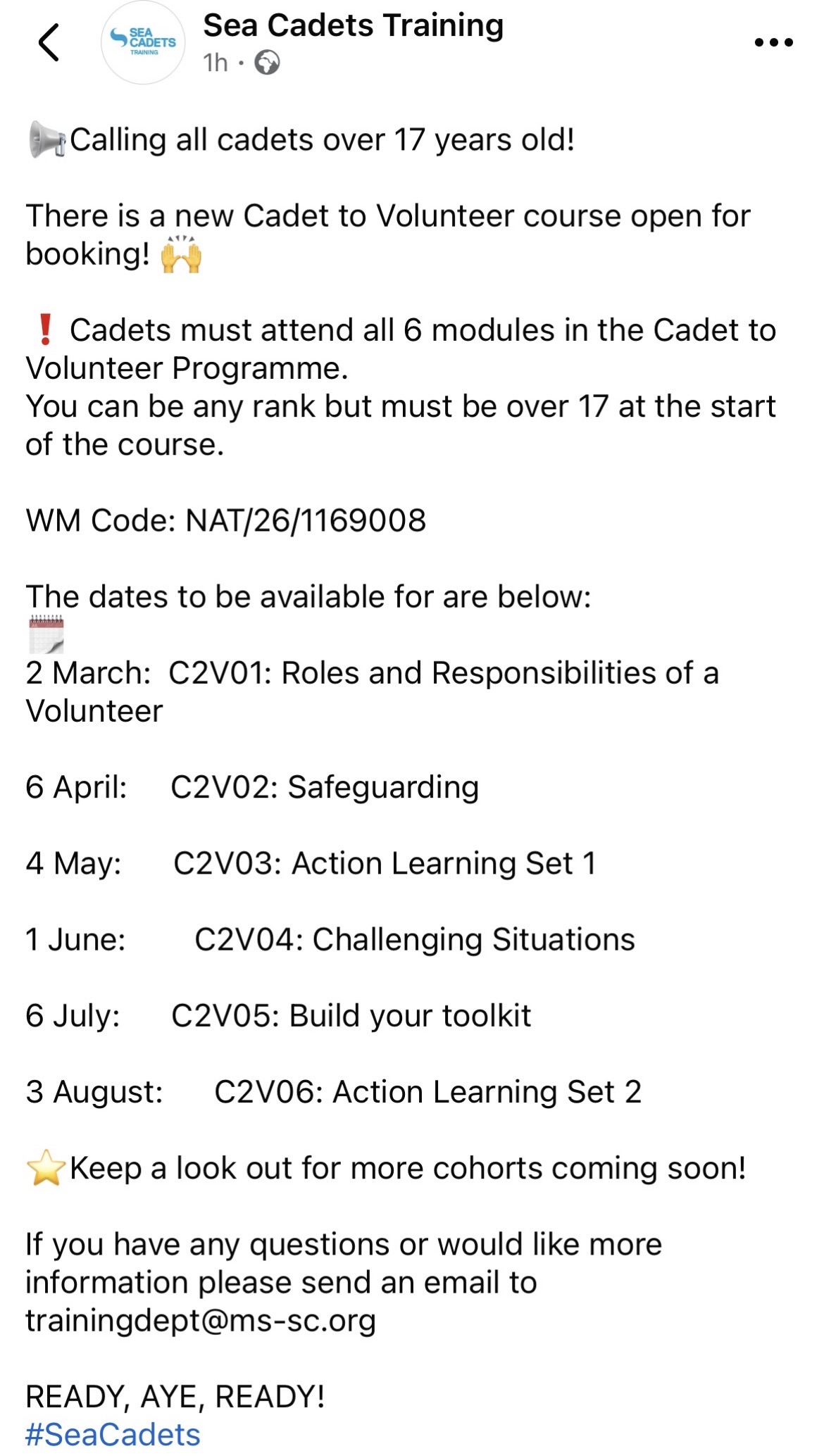
Sea cadets have a “Cadet to volunteer” course on those sort lines albeit over two separate weekends for a Mod1 & Mod2.
Might be worth seeing if you can go along to observe one.
That could be awesome for adding a bit of meat to the bone of my idea.
I’m also conscious I never did CIC, so until my newest SNCO does it (or someone here tells me), I’m pondering without a full understanding of what we already achieve.
Dorset/wilts has had one.
I also think we make too much of a deal about choice of route. I think a volunteer will find their way into the ‘job’ they want to do, regardless of entry route. If that means they commission from SNCO then they will do it. We no longer formally train our SNCOs differently to officers so how can we expect different results in their early ‘career’? Each individual will organically develop, find their niche, and ultimately leave when the time is right for them, and their choice of initial shoulder attire (or lack of) will be irrelevant.
This is sort of why I favour bringing everyone in as an NCO and then only commissioning for those relatively few roles that actually “require” a commissioned officer.
What would we be talking about really for commissioned officers when everything else is already about qualifications and experience, rather than rank?
Literally everything else could be an extended NCO pathway, with sgt being for experienced staff with time under their belts, adj and training officer appointment-based promotion to sgt which mirrors the parent service (at least for adj), then FS and WO reserved for more senior roles, such as sector NCO, WWO etc.
We could utilise the lower ranks for growth and reward, as we have in the parent service and reserves.
No need to juggle loads of commissioned roles and have people crossing that one-way threshold unless they’re taking on a significant leadership role and then holding it for long enough.
As we’ve discussed, there’s nothing “less than” about being an NCO. We just perhaps need to add a bit more range in terms of available ranks to avoid the sense that we’re “devaluing” the SNCO cohort.
There’s also merit in ensuring people really can do basic military things like drill before we commission them, which would be helped if people were in a junior rank uniformed position for a bit before being selected for commissioning — I can’t see us wanting to propel too many people into command before they’ve had a year getting to know the role of a CFAV and how everything works.
People who want to lead a unit should definitely have proven that they can stand in front of an audience / do drill to a decent standard first — just as we don’t want to feed NCO stereotypes, we don’t want to feed officer ones either!